Painting a 1950s to 60s block or brick ranch in central Phoenix: painted block, efflorescence and the right primer
October 23, 2026 · 14 min read · Written by Deci Hernandez
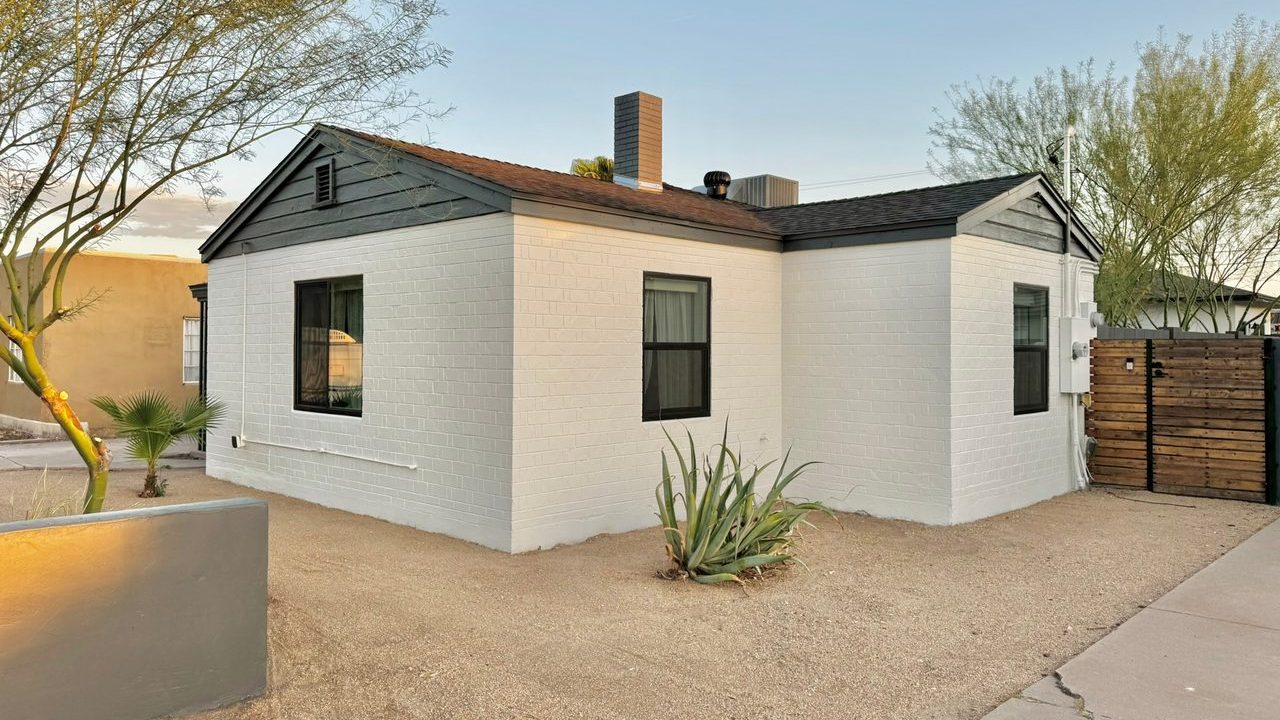
A 1950s or 60s block or brick ranch in central Phoenix gets painted in four steps that do not change: pressure wash, let the masonry dry all the way through, prime with a masonry primer that tolerates alkali up to pH 13, and back-roll two coats of a quality exterior acrylic into the texture. What decides whether it lasts is where the efflorescence is coming from, usually flood irrigation or sprinklers against the wall, and, on a pre-1978 house, how the old paint is handled. That is a different job from a stucco repaint, and the quote you get rarely explains why. This guide does, with the data sheets behind it and a real central Phoenix masonry job, the white brick and black trim repaint in central Phoenix, as proof of what the prep looks like on exterior house painting in Phoenix.
At a glance
- Masonry primers made for alkaline walls: Sherwin-Williams Loxon Concrete & Masonry Primer-Sealer is rated for pH 6 to 13; Dunn-Edwards Eff-Stop Premium is rated for masonry up to pH 13
- Block filler on bare block covers only 50 to 100 sq ft per gallon, against 200 to 320 sq ft per gallon for the Loxon primer
- SRP schedules residential flood irrigation about every 14 days from April to September and every 28 days from October to March
- EPA: 87% of homes built before 1940 and 24% of homes built 1960 to 1978 have some lead-based paint; a 1950s house sits between those two figures
- The EPA renovation rule exempts only small jobs: 6 sq ft of paint per interior room, 20 sq ft on the exterior
Is my central Phoenix house Superlite block, painted block or brick, and why does it matter for paint?
Look at the face of the wall. Odds are a central Phoenix ranch of this era is Superlite block, made by the Phoenix block maker: Docomomo US's history of Superlite says 75 percent of all new buildings in the Valley were going up in Superlite concrete block by 1955. Plain Superlite block has a flat, even face. Its slump block line has a soft bulge on every unit, because Superlite pressed each block slightly before it cured, and that integrally colored block "required no painting," which is why so much of it was painted later by owners and now fails in layers. Brick is smaller, fired clay with thin mortar joints.
The neighborhood tells you the era. Maryvale was planned by John F. Long in 1954 and was selling 125 homes a week by 1956. Sunnyslope's five Upshaw subdivisions went in between 1945 and 1955. Arcadia started as citrus lots, and most of the housing in its village dates from 1950 to 1970. Encanto Manor is the city's listed historic district for 1945 to 1959. Willo is older, brick bungalows and revival styles with a period of significance of 1910 to 1950, so in this guide it is the painted-brick, pre-1978 case rather than a 1950s ranch.
The material changes the job. Block is porous and alkaline, so bare or stripped block gets a block filler and then a primer rated for high pH. Painted brick skips the filler and gets the same primer. Crumbling mortar joints are a mason's work before ours. Brick or block that has never been painted is a different conversation: the Phoenix Historic Preservation Office (602-261-8699) discourages painting masonry that was never painted, and this guide is about walls that already carry paint.
What is the white crust on my block wall, and where is the water coming from?
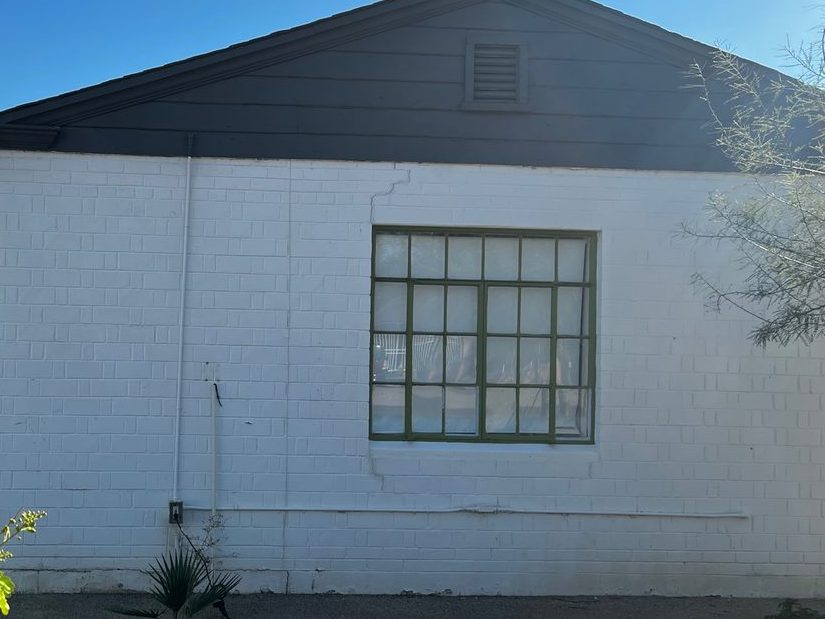
The white crust is efflorescence: soluble salts that water carries out of the block or the mortar and leaves behind when it evaporates. The Dunn-Edwards technical bulletin lists three conditions that all have to be present at once: salts in the masonry, water reaching those salts, and a path for them to migrate to the surface, usually cracks or pores. On brick and block it often shows as narrow bands that follow the mortar joints, and Sika's bulletin notes it shows most in the cooler months, when cool days and nights bring out salts that stayed hidden all summer.
In central Phoenix the water is rarely a mystery. If your lot takes SRP flood irrigation, the yard floods about every 14 days from April to September and every 28 days from October to March, and the bottom courses of the wall stand in that water. Sprinkler heads aimed at the house, drip emitters set against the block, a planter built against the wall and a dripping hose bib do the same thing on a smaller scale. Sherwin-Williams' guidance is to find and fix the moisture source first, because the crystals keep growing as long as salt and water are both present.
Painting over it does not work. Dunn-Edwards says the deposits keep growing and cause adhesion problems if they are not removed before repainting, and Sika's bulletin says the salts can migrate right through an acrylic finish. That is the peeling along the bottom of the wall that a stucco repaint never shows.
How do you prep painted block and brick so the new paint stays on?
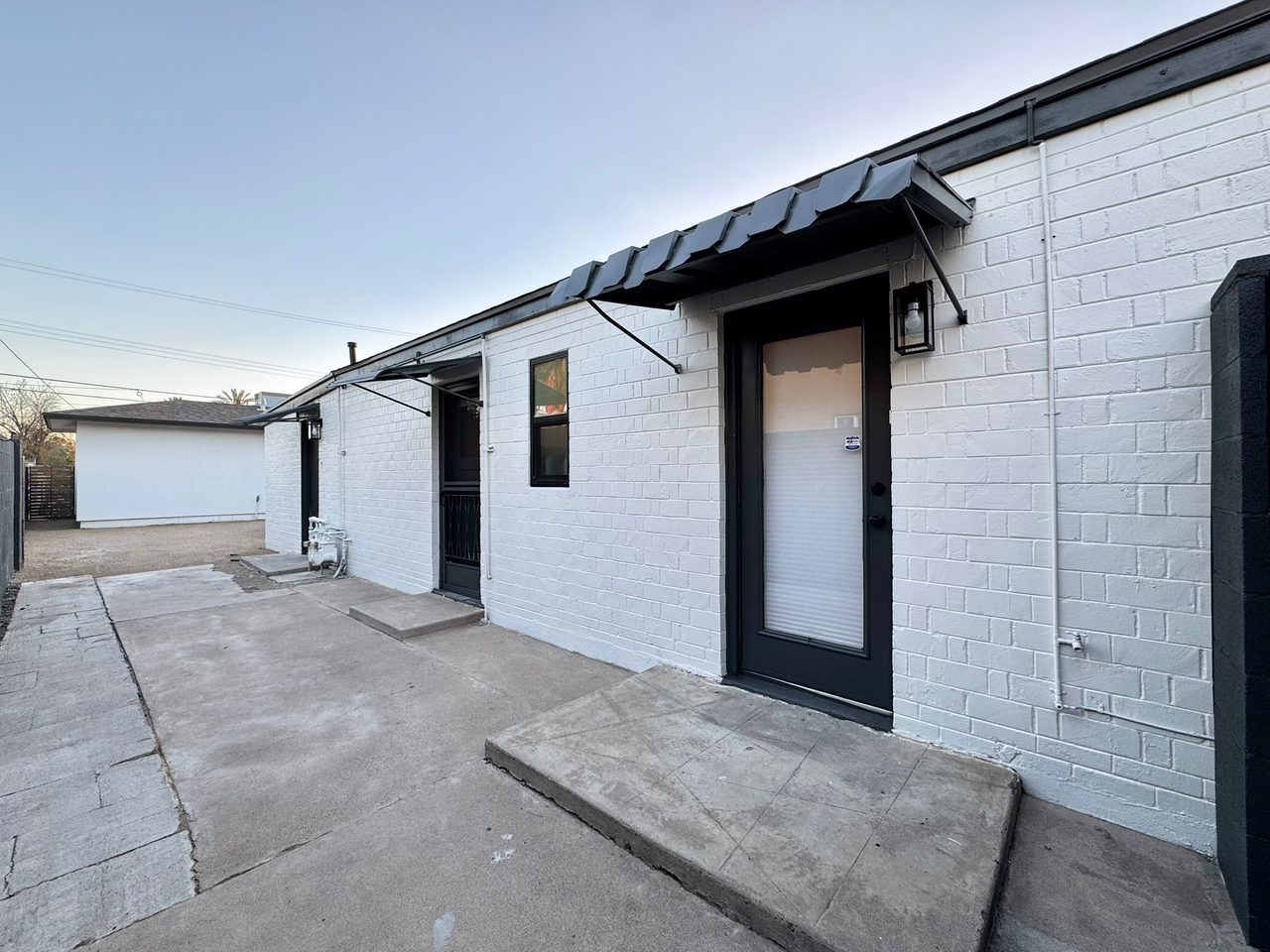
Wash first, but not the way you would blast a stucco wall. On the white brick and black trim house we pressure washed the whole house to strip off the chalky residue the sun leaves behind, plus dirt and any loose, failing paint. Where efflorescence is active, Sherwin-Williams says high-pressure water can make it worse, so the salts come off mechanically, with a wire brush or a power brush, followed by a thorough rinse. The Dunn-Edwards bulletin goes one step further on a highly alkaline wall: a wash of one part phosphoric acid to seven parts water, with citric acid as the safer and slightly weaker option, then a full rinse.
Then the wall dries, all the way. Brick and block are porous and hold water, and painting over a damp wall is how you get blisters and peeling down the road, so the wall has to come back to dry before anything else happens. The Loxon primer sheet allows a damp surface but not a wet one, and Sherwin-Williams says to delay painting if efflorescence keeps appearing.
Repairs come next. Open gaps in the brick get a masonry-grade patching compound, never interior spackle, and peeled or checked paint comes off to a sound surface. The Loxon sheet is blunt about it: any prep short of total removal of the old coating can shorten the life of the new system. Painted masonry that still powders after the wash gets a conditioner such as Sherwin-Williams Loxon Conditioner before the finish. For the full walk-through, see the white brick and black trim repaint in central Phoenix and why exterior paint chalks and peels here; the repairs fall under our masonry and stucco repair.
Which masonry primer and block filler do Phoenix painters use, and when?
Two primers cover most of the painted block and brick in the Valley, and both come from stores across the metro. Sherwin-Williams Loxon Concrete & Masonry Primer-Sealer is an acrylic rated highly alkali and efflorescence resistant on surfaces from pH 6 to 13. Its sheet calls for masonry at least 7 days old, no application below 40°F, a topcoat within 14 days outdoors, and about 200 to 320 sq ft per gallon, dropping to 80 on rough, porous surfaces. Dunn-Edwards Eff-Stop Premium is an epoxy-fortified acrylic primer-sealer for masonry up to pH 13, with a 50°F minimum, 225 to 275 sq ft per gallon and a recoat window of 2 to 4 hours. Both sheets want the wall cured, clean, dry and free of efflorescence and chalk before the primer goes on.
A block filler is a different product, and it belongs only on bare or stripped block. Sherwin-Williams Loxon Acrylic Block Surfacer and Dunn-Edwards Smooth Blocfil Premium are heavy-bodied 100% acrylics that fill the pores and pinholes so the finish does not sink into them. Both cover only 50 to 100 sq ft per gallon, both get rolled or back-rolled into the pores and mortar joints, and neither goes over slick surfaces or sound existing paint. The Loxon primer sheet says porous block needs a coat of the surfacer to get a pinhole-free wall, and the Blocfil sheet says that if efflorescence exists, you remove it and prime with Eff-Stop before the filler. Behr's masonry guidance follows the same order, masonry primer and sealer first, and warns that an elastomeric does not belong on a wall with moisture coming through it.
The system on top is one coat of primer and two coats of finish, back-rolled.
| Block and brick repaint facts for central Phoenix | Figure, with unit | Where it comes from |
|---|---|---|
| Masonry primer alkali tolerance | pH 6 to 13 (Loxon Concrete & Masonry Primer-Sealer); up to pH 13 (Eff-Stop Premium) | Sherwin-Williams data sheet 7/2023; Dunn-Edwards sheet 07/21 |
| Block filler alkali tolerance | pH 8 to 13 (Loxon Acrylic Block Surfacer); up to pH 12 (Smooth Blocfil Premium) | Sherwin-Williams sheet 10/2021; Dunn-Edwards sheet 07/21 |
| Primer coverage | 200 to 320 sq ft per gallon, 80 sq ft per gallon on rough porous surfaces (Loxon); 225 to 275 sq ft per gallon (Eff-Stop) | Same two sheets |
| Block filler coverage | 50 to 100 sq ft per gallon (Loxon Block Surfacer and Smooth Blocfil Premium) | Same two filler sheets |
| Minimum application temperature | 40°F (Loxon primer); 35°F (Loxon Block Surfacer); 50°F (Eff-Stop and Smooth Blocfil) | Data sheets |
| Topcoat window after the Loxon primer, outdoors | within 14 days | Loxon primer sheet |
| New masonry cure before priming | at least 7 days | Loxon and Eff-Stop sheets |
| SRP residential flood irrigation | about every 14 days April to September; every 28 days October to March | SRP flood irrigation FAQ |
| Homes with some lead-based paint, by age | 87% of homes built before 1940; 24% built 1960 to 1978 | US EPA |
| EPA renovation rule, minor-repair exemption | 6 sq ft per interior room; 20 sq ft exterior | 40 CFR 745.83 |
| Masonry wall in direct sun, our reading on a central Phoenix job | well over 100°F, often 40°F hotter than the air | The white brick and black trim story |
| Exterior painting, national market claims | $1.50 to $4 per sq ft (any siding); $2.50 to $5.00 per sq ft (brick) | HomeAdvisor (June 2026); HomeGuide (2026) |
Sources: Sherwin-Williams Loxon product data sheets (2021, 2023); Dunn-Edwards Eff-Stop Premium and Smooth Blocfil Premium product information sheets (2021); SRP flood irrigation FAQ; US EPA lead pages and 40 CFR 745.83; HomeAdvisor and HomeGuide national cost pages, which are market claims, not quotes; all read October 22, 2026.
What about lead paint on a house built before 1978?
Treat it as likely until someone proves otherwise. The federal government banned lead-based paint for homes in 1978, and EPA's own figures are that 87% of homes built before 1940 and 24% of homes built between 1960 and 1978 have some lead-based paint; a 1950s house sits between those two numbers. The paint most likely to be old is on the wood: trim, fascia, doors and window frames.
EPA's Renovation, Repair and Painting rule covers anyone paid to disturb painted surfaces in a home built before 1978, painters included, and it requires the firm to hold EPA firm certification and its workers to be trained in lead-safe work practices. That applies to every firm, even a sole proprietorship, a firm cannot advertise or perform that work without the certification, and in Arizona the program is run by EPA itself, not the state. The exemption is small: minor repair and maintenance that disturbs 6 square feet or less of paint per interior room, or 20 square feet or less on the exterior, with window replacement and demolition always covered. Testing is not required, but unless there is documentation that the paint is not lead-based, the rule applies. Even the primer sheets carry the warning: Loxon's says scraping or sanding old paint may release lead dust, and Dunn-Edwards' names pre-1978 buildings outright.
What you can do before anyone sands: ask any painter you are considering for the firm's EPA certificate. If you want to know what is on the trim, EPA recommends a lead inspector or risk assessor who holds the EPA certification, and the National Lead Information Center is 1-800-424-LEAD (5323). Hardware stores sell test kits, but EPA's recognition of the three kits it lists applies only when a renovator with the EPA certification uses them.
How much does it cost to paint a block or brick ranch in central Phoenix?
Market pages put exterior painting nationally at $1.50 to $4 per square foot (HomeAdvisor, updated June 17, 2026) and a brick house at $2.50 to $5.00 per square foot (HomeGuide, 2026), and Angi's Phoenix page puts a one-story exterior at $1,225 to $2,875 for 1,000 to 1,500 square feet of paintable wall (updated November 14, 2025). Those are market claims, not our prices. What moves a masonry quote above a stucco one is mostly material and waiting. Bare or stripped block takes a filler coat at 50 to 100 sq ft per gallon before the primer even starts, against 200 to 320 sq ft per gallon for the Loxon primer. Active efflorescence adds the brushing, the rinse and the days of drying before anyone opens a can. Wood trim and fascia that need filling, a pre-1978 house with painted wood, and a dark trim color that has to be worked by shade all add hours. A quote that names the primer and lists the filler as its own line is the one you can compare. Our exterior house painting estimate is free and lists all of it.
When should a block house be painted in Phoenix, and why does the wall stay hot after sunset?
The cooler months are the easy answer, and the best time to paint an exterior in Phoenix covers the calendar. Masonry adds a twist at both ends. A masonry wall in direct Phoenix sun can run well over 100°F, often 40 degrees hotter than the air, and a dark color like black trim runs hotter still. Brick and block also hold heat late into the evening, which is why we work the elevations by shade instead of by the clock. The National Weather Service counted 143 days at or above 100°F in Phoenix in 2024. On the cold end, the block filler and Eff-Stop sheets want 50°F air and surface, and the Loxon primer wants 40°F with no drop below it for 48 hours after, so a January week with cold nights is planned around the forecast, not the afternoon high. Color matters on masonry too: how color affects wall heat explains LRV.
Worth adding while the masonry is clean and primed
The wash, the masking and the shade schedule are already paid for once the body is primed, so the pieces that share that setup are the cheap ones to add. On a ranch of this era that usually means the wood trim, fascia and eaves in the trim color, the front door and the security door, carport posts and beams, and the steel window grilles and metal awnings that went black on the white brick house. A stucco addition or a patched gable gets its crack repair under masonry and stucco repair before the color, and if you are repainting inside the same month, interior painting can run while the exterior dries. Loose or missing mortar is a mason's repair and lead abatement is a specialist's; we will tell you when either one is needed. Finished examples are in our gallery.
Want to know what is under your paint?
Send us a photo of the wall, the white crust and the sprinkler head, and the year the house was built. The estimate is free: call or text (602) 405-4533 or use the contact form. For a painted brick ranch before and after, see the white brick and black trim repaint in central Phoenix and the rest of the gallery.
Frequently asked questions
- Can efflorescence come back after the wall is painted?
- Yes, if the water source stays. Sherwin-Williams says the crystals keep growing as long as salt and moisture are both present, and the Sika bulletin says the salts can migrate through an acrylic finish. Move the water first (the sprinkler head, the emitter, the planter against the wall), let the wall dry, and prime with a masonry primer rated for efflorescence. Prime over a wet source and the paint lifts again.
- Does unpainted Superlite block need to be painted at all?
- No. Superlite block was made to be left bare, the plain gray block and the integrally colored slump block alike, and the Phoenix Historic Preservation Office discourages painting masonry that has never been painted. Once block has been painted it stays painted in practice: the Loxon sheet says any prep short of removing all of the old coating limits how long the next one lasts, and the HPO says that if paint is removed from masonry it should be by the gentlest means, never sandblasting.
- Do I need block filler on block that is already painted?
- Only on bare or stripped spots. Block filler fills the open pores and pinholes of unpainted block and covers just 50 to 100 sq ft per gallon. The Loxon Acrylic Block Surfacer sheet says not to apply it over smooth, slick surfaces and to remove peeled or checked paint to a sound surface first. Sound painted block gets the masonry primer where it needs it and then the two finish coats.
- Can a block or brick house be painted a dark color in Phoenix?
- Yes, with the heat in mind. A masonry wall in direct Phoenix sun already runs well over 100°F, often 40 degrees hotter than the air, and a dark color runs hotter still, so it gets applied by shade and it will show its age sooner on the south and west walls. On the white brick house in central Phoenix the dark color stayed on the trim, fascia, doors and awnings and the body went white. Our guide on exterior colors that keep an Arizona home cooler explains how to read LRV before you choose.
- How do I find out whether the trim on my 1962 house has lead paint before anyone sands it?
- EPA puts 24% of homes built between 1960 and 1978 with some lead-based paint, so assume it until tested. EPA recommends hiring a lead inspector or risk assessor who holds the EPA certification; the National Lead Information Center at 1-800-424-LEAD (5323) can help you find one. Hardware stores sell test kits, but EPA recognizes only three (LeadCheck, D-Lead and the Massachusetts kit), and only when a renovator with the EPA certification uses them. Any painter you hire can show you the EPA firm certificate.
Where this information comes from
- Sherwin-Williams: Loxon Concrete and Masonry Primer-Sealer data sheet, 7/2023 (pH 6 to 13, 7 days, 40°F, 14-day topcoat window, coverage)
- Sherwin-Williams: Loxon Acrylic Block Surfacer data sheet, 10/2021 (pH 8 to 13, 35°F, 50 to 100 sq ft per gallon)
- Sherwin-Williams: Loxon Conditioner product page (powdery painted masonry)
- Sherwin-Williams: Duration Exterior data sheet, 3/2026 (block surfacer on CMU at 50°F, conditioner on chalky painted masonry)
- Dunn-Edwards: Eff-Stop Premium masonry primer information sheet (up to pH 13, 50°F, coverage, pre-1978 caution)
- Dunn-Edwards: Smooth Blocfil Premium block filler information sheet (50 to 100 sq ft per gallon, back-roll, pH up to 12)
- Dunn-Edwards: Efflorescence technical bulletin (the three conditions, the acid wash)
- Sherwin-Williams: Efflorescence, causes and fix (sherwin-williams.com)
- Sherwin-Williams: Maintenance and repair FAQs (high-pressure water and efflorescence)
- Behr: Efflorescence and mottling (behr.com)
- Sika Senergy: Prevention and treatment of efflorescence, technical bulletin, March 2024
- SRP: Flood irrigation schedule (srpnet.com)
- US EPA: Lead Renovation, Repair and Painting Program (epa.gov)
- US EPA: Renovation, Repair and Painting Program for contractors (the 6 and 20 sq ft exemption)
- US EPA: How to tell if your home has lead-based paint (epa.gov)
- US EPA: Lead test kits (epa.gov)
- eCFR: 40 CFR 745 Subpart E (ecfr.gov)
- City of Phoenix: Historic Preservation FAQ (phoenix.gov)
- City of Phoenix: Residential historic districts (Willo, Encanto Manor)
- City of Phoenix: Maryvale Village Character Plan (phoenix.gov)
- ASU Cronkite News: Maryvale history (125 homes a week by 1956)
- City of Phoenix: Camelback East village (housing built 1950 to 1970)
- Modern Phoenix: Sunnyslope (Upshaw subdivisions 1945 to 1955)
- Docomomo US: The Story of Superlite
- NWS Phoenix: 2024 year in review (143 days at or above 100°F)
- Angi: cost to paint the exterior of a house in Phoenix, updated November 14, 2025 (market claim)
- HomeAdvisor: cost to paint a home exterior, national, June 2026 (market claim)
- HomeGuide: cost to paint a house exterior, national, 2026 (market claim)

Ready for a fresh coat?
Get a Free Estimate